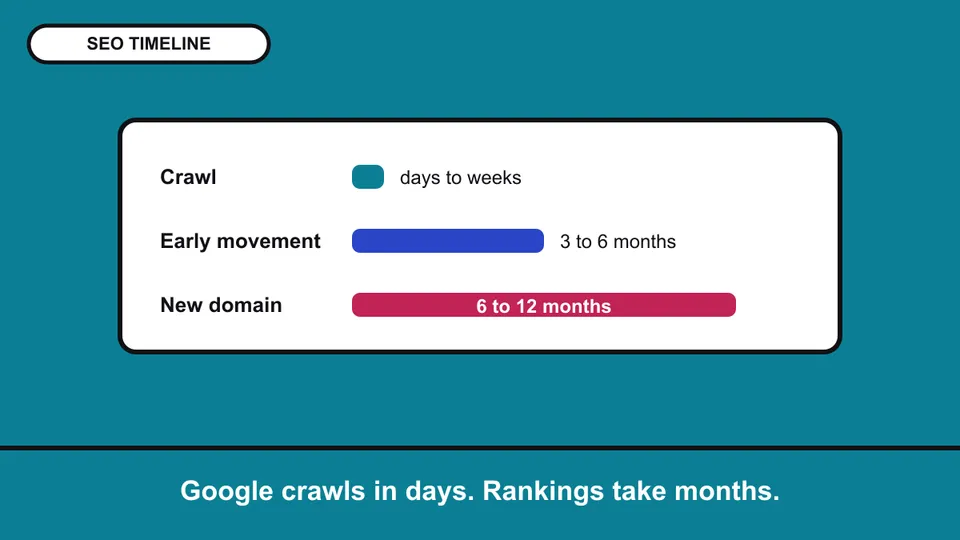
Plan for 3 to 6 months before early movement and 6 to 12 months before results are substantial. A new domain or a competitive term usually takes longer. Google gives the crawl timing, a few days to a few weeks. The ranking ranges come from agency estimates, so use them to plan, not to promise.
What Google says about timing
Google separates finding a page from ranking it, and it is clear about the first part. Crawling can take anywhere from a few days to a few weeks. Requesting a crawl does not guarantee that a page will appear in search results instantly, or at all, and asking again for the same URL does not make it crawl faster.
So the first milestone is simple to check: has Google crawled and indexed the page? The ranking timeline only starts after that. The URL Inspection tool in Search Console shows the status of a single page.
How long SEO takes to show results
For most sites, expect 3 to 6 months before you see early movement, and 6 to 12 months before results are substantial. A new domain or a competitive term usually takes longer. These ranges come from Australian agency estimates, not from Google, so use them to plan rather than to promise.
Early movement means impressions rise and positions improve on terms with lower competition. Substantial results mean clicks and enquiries grow steadily over several months, not one good week.
What to measure, and when
Measure in the order search works: crawl first, then impressions, then position, then clicks. Google Search Console’s performance report shows the last three months by default, so compare like with like and do not judge a change after a week.
In my experience, impressions usually rise before clicks. If you judge the work by clicks in the first month, you will miss progress that is already happening.
| When | What to check | Where to check it |
|---|---|---|
| Months 1 to 2 | Pages are crawled and indexed | URL Inspection tool and the Pages report |
| Months 3 to 4 | Impressions and average position for your target terms are rising | Performance report, filtered by query and page |
| Months 5 to 6 and beyond | Clicks and enquiries grow, and you can see which pages bring them | Performance report, plus your analytics and enquiry log |
Why the range is so wide
Four things explain most of the gap between a 3-month wait and a 12-month wait.
- Domain age. Ahrefs reports that only 5.7% of newly published pages will rank in Google’s top 10 within a year of publication. Its statistics page also finds that 72.9% of pages ranking in the top 10 are more than three years old. A new site has to build the trust that older sites already have.
- Competition. A phrase with many strong competitors takes longer than a specific phrase with few. Check keyword difficulty as well as search volume. A high-volume term can stay out of reach for a new site for a long time.
- Blockers. A robots.txt file that blocks crawlers, slow pages, broken links or missing titles can hold a whole site back. Fix these first, because nothing else works until Google can reach and read the pages.
- Consistency. Stop-start work resets progress. Steady monthly work on pages and links beats a burst of changes followed by a long pause.
What you can do to shorten the wait
None of these guarantees a faster result, but each one removes a common reason for delay.
- Answer one question clearly on each page. A page built around one question and one service is easier for Google to understand than a broad page that covers everything.
- Keep the sitemap current. Submit it in Search Console and update it when you add or remove pages.
- Link related pages together. Link each article to the service page it supports, so readers and Google can follow the topic.
- Earn real mentions. Credible links and mentions from customers, directories and partners take time to build, but they last longer than anything bought quickly.
Be wary of fast promises
Any offer that promises page one within a fixed number of days is a sales claim, not a forecast. Before you agree to anything, ask three things: what the work is, how progress will be reported, and what happens if the target is missed. A good provider can answer all three in writing.
The short version
Expect months, not weeks. Keep the site crawlable, fix the blockers first, and measure the stages in order. If you want to know where your site stands today, a free AI visibility audit shows what is blocking progress and what it would cost to improve, before you commit to anything.
Quick answers
For most sites, expect 3 to 6 months before you see early movement, and 6 to 12 months before results are substantial. A new domain or a competitive term usually takes longer. These ranges come from Australian agency estimates, not from Google, so use them to plan rather than to promise.
Four things explain most of the gap between a 3-month wait and a 12-month wait.
Measure in the order search works: crawl first, then impressions, then position, then clicks. Google Search Console’s performance report shows the last three months by default, so compare like with like and do not judge a change after a week.
None of these guarantees a faster result, but each one removes a common reason for delay.
Google separates finding a page from ranking it, and it is clear about the first part. Crawling can take anywhere from a few days to a few weeks. Requesting a crawl does not guarantee that a page will appear in search results instantly, or at all, and asking again for the same URL does not make it crawl faster.
SOURCES
- Google Search Central, "Ask Google to recrawl your URLs" (crawling can take a few days to a few weeks; a request does not guarantee inclusion)
- Ahrefs, "SEO statistics" (5.7% of newly published pages rank in the top 10 within a year; 72.9% of top-10 pages are over three years old)
- Google Search Console Help, "Performance report" (the default view covers the past three months)
- RedSearch, "How Long Does SEO Take?" (Australian agency estimates: 3 to 6 months for established sites, 6 to 12 months for new sites)
- WebFX, "How Long Does SEO Take? A Look Into SEO Timelines" (agency estimate: three to six months)